

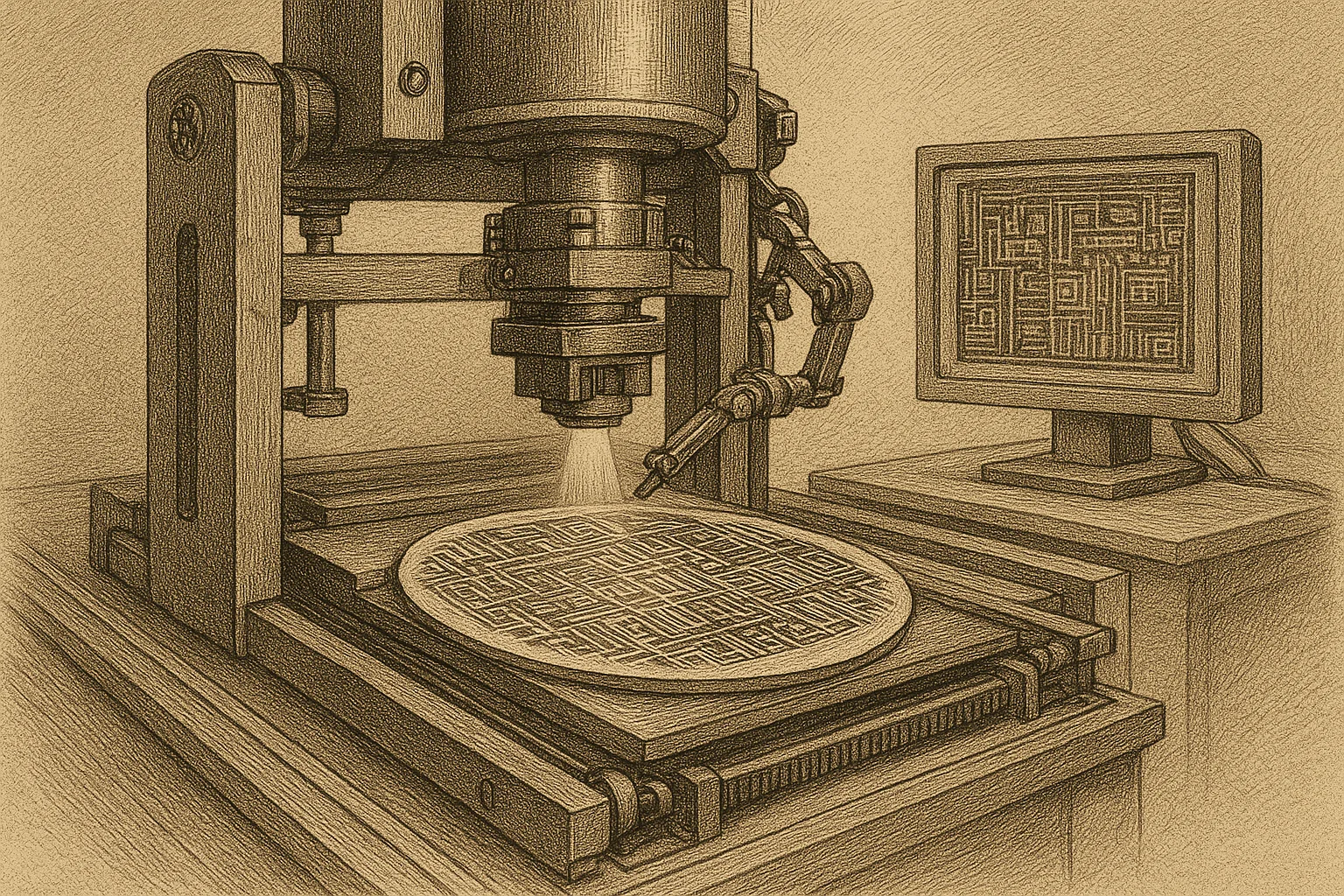

Lithography machines are arguably the most critical and sophisticated tools in the semiconductor industry. These marvels of engineering are responsible for creating the intricate patterns that form integrated circuits (chips) on silicon wafers. Without them, the advanced microprocessors, memory chips, and other electronic components that power our modern world simply would not exist.
The fundamental principle behind a lithography machine is similar to that of a projector. It uses light to transfer a design from a photomask (a stencil-like plate with the desired circuit pattern) onto a silicon wafer coated with a light-sensitive material called photoresist. The light selectively hardens or softens the photoresist, creating a pattern that can then be etched into the silicon, forming the tiny transistors and interconnections that make up a chip.
As chips have become exponentially smaller and more complex, the demands on lithography machines have escalated dramatically. Modern advanced nodes require extreme ultraviolet (EUV) lithography, which uses light with a wavelength of just 13.5 nanometers – orders of magnitude smaller than visible light. This allows for the printing of features that are only a few atoms wide. EUV machines are incredibly complex, often weighing over 180 tons and costing hundreds of millions of dollars, with components like highly precise mirrors, vacuum systems, and a plasma light source.
The continuous innovation in lithography technology is a key driver of Moore's Law, enabling ever-smaller, faster, and more power-efficient chips. Companies like ASML, a Dutch firm, dominate this highly specialized market, pushing the boundaries of physics and engineering to deliver the tools essential for the digital age.
Comments (0)